Radak
Rabbi David Kimchi, known by the acronym Radak — רד״ק, Rabbi David Kimchi — was one of the great masters of Hebrew grammar, Biblical interpretation, and the careful study of Lashon HaKodesh. He lived in Narbonne, in Provence, in the late twelfth and early thirteenth centuries, and his writings became central works for students of Tanach and Hebrew language.
His father, Rabbi Yosef Kimchi
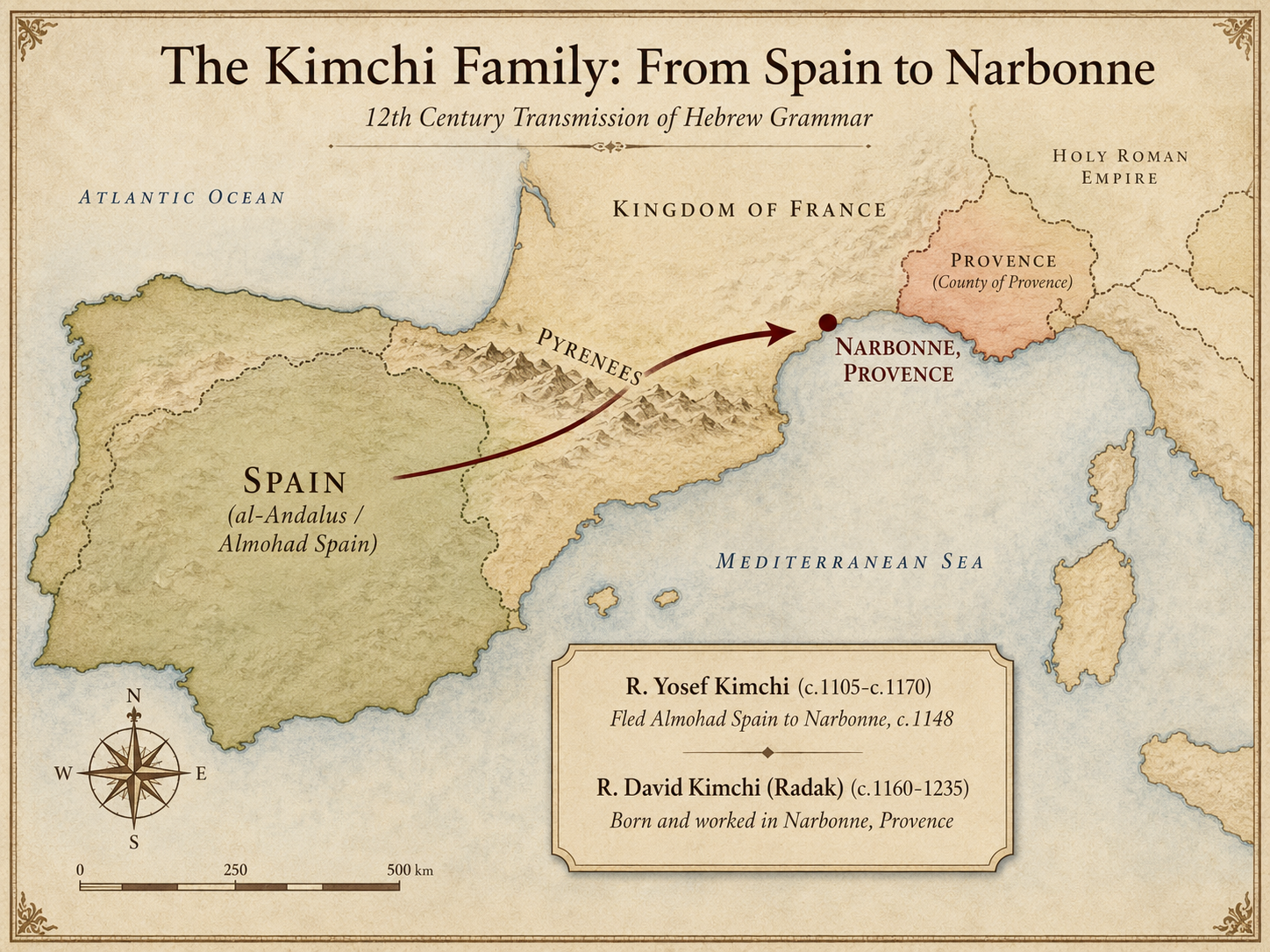
Radak did not appear in isolation. He came from the remarkable Kimchi family, a family deeply devoted to Hebrew grammar, Biblical explanation, translation, and the defense of Jewish learning. His father, Rabbi Yosef Kimchi, was born in Spain and later settled in Narbonne. Through his teaching and writing, Rabbi Yosef Kimchi helped bring the refined Hebrew grammar tradition of Spain into Provence, where it could be studied and developed by a wider Jewish audience.
Rabbi Yosef Kimchi was himself a grammarian, translator, commentator, and defender of Judaism. His work helped prepare the path for his son Radak, whose writings would become the best-known and most enduring expression of the family’s language tradition.
The family transmission
Radak was still young when his father passed away. His older brother, Rabbi Moshe Kimchi, helped guide his education, but Radak’s own greatness soon became clear. He became known not only as a grammarian, but also as a teacher, commentator, and public defender of Jewish interpretation.
Radak’s achievement
Radak’s great achievement was that he made Hebrew grammar usable. Earlier grammatical learning could be difficult, scattered, or written for advanced scholars. Radak gathered the principles of Hebrew language into a clearer structure. He explained roots, letters, vowels, forms, and usage in a way that served the serious student of Scripture.
His major grammatical work is known as Sefer HaMikhlol, “The Book of Completeness.” Within this work, the grammatical section became known as Sefer HaDikduk, and the lexical section became known separately as Sefer HaShorashim, “The Book of Roots.” Together, these works gave students a powerful way to understand Hebrew words from the inside: their roots, their forms, and their meaning in Tanach.
Major works
- Sefer HaMikhlol / Sefer HaDikduk — Radak’s major presentation of Hebrew grammar.
- Sefer HaShorashim — his root-word lexicon, used for understanding Hebrew vocabulary in Tanach.
- Et Sofer — a work connected with the accurate writing and reading of Scripture.
- Commentaries on Tanach — including important commentaries on the Prophets, Tehillim, Divrei HaYamim, and Bereshis.
Why this site exists
For generations, Radak’s works shaped the study of Hebrew grammar and Biblical interpretation. Jewish students used his writings to understand Tanach more precisely relying heavily on his grammar and lexicon.
This site is devoted to that legacy. Its purpose is to present Radak’s language works in a clear and accessible form, while preserving the seriousness of the original. By studying Radak’s grammar and root system, the student gains more than definitions. The student learns how Hebrew words are built, how Scripture speaks, and how careful language study opens the text of Tanach.
Sources and note
This page is a short educational summary. Dates and the map route are approximate. For further reading, see general biographies and reference entries on Radak and the Kimchi family, including Chabad.org’s biography of Radak, Encyclopaedia/Britannica entries on David Kimchi, and other standard Jewish-history references.